Wednesday, May 09, 2007

New Propaganda

I happened upon a quote by Terry Goodkind from his novel Phantom, which I have not read. It inspired my comments below. If you can't bear to read the whole thing, then you should be able to get the point from reading just the first few sentences:
Like all irrational beliefs, it was also unworkable. To live, those beliefs had to be ignored to accomplish goals of domination, which in themselves were a violation of the belief for which they were fighting. There were no equals among those of the Order, the torchbearers of enforced equality. Whether a Ja'La player, the most professional of the soldiers, or an emperor, the best were not simply needed but sought after and highly valued, and so as a body they harbored an inner hatred of their failure to live up to their own teachings and a fear that they would be unmasked for it. As punishment for their inability to fulfill their sanctified beliefs through adherence to those teachings, they instead turned to the self-flagellation of proclaiming how unworthy all men were and vented their self-hatred on scapegoats: they blamed the victims.

Through an act of deep magic, I have developed my very own literary crystal ball, and here is what my probing vision reveals: The "philosophical novel" is going to be the next genre. (Or, at the very least, the future of New Romanticism is going to be burdened with too much dense, quasi-philosophical prose.)

Pray, let this not come to pass.

We writers, by and large, are nothing like real philosophers. Few of us have integrated -- or will ever integrate -- enough particulars to write competently about the sort of broad, philosophic themes that Ayn Rand deftly tackled. And when a writer wants to tackle lofty themes but lacks particulars to draw upon, he will always resort to bald reporting. That's why this new genre's guiding principle -- or so I gather -- will be to tell and not to show.

This should never happen to an Objectivist.

More than any other literary theory in history, Ayn Rand's romantic realism respects the mind, both the reader's and the writer's. The romantic realist illustrates his ideas primarily in the form of images using words, which themselves primarily denote action, to which the reader responds via an active and deeply familiar mental process -- the process of looking at "reality" and perceiving it. The effect of this kind of transaction between writer and reader is an enormous commitment to story, and a sense of traveling on an emotionally complex thrill-ride.

Clearly the most engaging fictional imagery emerges when a writer draws upon his own observations and integrations in the real world, by which I mean, from that which he knows in fact, not just in theory by means of reading other people's books. Qua romantic realism, Atlas Shrugged is not a boilerplate. It couldn't be even if it wanted to be, which it doesn't. (For Rand's view on this, see especially the taped version of her course "Fiction Writing".) That's because no writer living today even slightly resembles Ayn Rand. (Please forgive me if I have overlooked a budding genius among us.)

At the very least, by reading this passage by Goodkind, perhaps some of my readers may now understand more clearly why I have, at least in part, placed some psychological distance between my work and the explicit tenets of Objectivism. I don't wish to write in a philosophical genre. For that matter, I don't wish for anyone to -- unless they can do it the right way, which is to say, the very same way that I plan to write an adolescent adventure story.

Labels: , , ,

Tuesday, November 07, 2006

New Naturalism

I recently attended a Halloween party where I met another writer. Her horn-rimmed glasses screamed postmodernist, so I tried to keep the conversation away from writing, but this was not to be. She pressed me endlessly for personal details about my writing despite my attempts to demur until I finally gave in and said that I write a kind of new romanticism. She was thrown.

"There's naturalism and then there's romanticism," I tried to explain.

"But you're using those terms in a strange way," she instructed (not said but instructed).

I tried again: "Think of new romanticism as an action genre with killer heroes and extraordinary flights of fancy, only make it say something universal."

"But Hawthorne, The Scarlet Letter..." Her voice trailed off, then her eyes opened wider and her mouth drifted shut.

I could see that this was a smarter than average postmodernist. She was getting the point quite nicely. Disbelief, shock, possibly even fear — I've seen it before. Poor dear. Yes, we romanticists are back and we're not kidding.

(It just occurred to me that it must be tough to be a failed postmodernist. Social recognition is everything to them. Success is measured by popularity. It's democratic. But as for me, if my life is going to be worth living, then I'm going to live it my way, on my terms, to the beat of my own classical guitar. I don't need to be liked. Isn't that just infuriating, my dear postmodernist ghoul?)

Anyway, we exchanged a few more comments before she found an excuse to scurry away into the safety of the costumed crowd. It was an interesting exchange. She was especially shocked that I would accuse many modern writers of being naturalists.

"Russo, Dybek, Chandra — these are nothing like Tolstoy," she said flatly. "Tolstoy was a conventionalist."

I noted her careful omission of the word "Duh!"

She's right, in a way. Naturalists used to be serious writers. They knew their craft exceedingly well, and they created some of the most finely-wrought and brilliantly conceived novels ever written. Their history reads like a Who's Who of literature: Tolstoy, Lewis, James, Crane, Chopin, and Fitzgerald, to name a few.

But a new kind of naturalism seems to be emerging from today's colleges. Some fifteen years ago, I was glad to see it. I thought it was a rebellion against the infamous LSD years. Maybe it was, only it's proving to be a poor alternative. While these new naturalists do attempt something like realism — at times even hyper-realism — this time around much of it is gritty, nihilistic, politically narrow, culturally arrogant, militant, linguistically debased, and sloppy. In short, it's postmodern.

Here's a sample from the venerable Glimmer Train Press, vol 35, "Donna Aube" by Thomas Kennedy:
"Already tipsy, he poured a vodka in his kitchen, glanced across the courtyard at the blue and white lamp. It was not even blue and white, it was green and beige. He snorted, stood swaying at the sink, infinitely grateful that he had said nothing suggestive to the young woman in the library. Yet the mere chance that he might have troubled him. Why? She might have wanted me. And? He thought of his dark-eyed student Marissa, of the woman who had phoned him the night before whom he perhaps would never see again, of his ex-wife's once-beautiful aunt with the melting-wax face, and reached up to the box of Havana Wilders. There were still two in the box.

He decided abruptly to allow himself to smoke them both. And then what?

'And then nothing,' he said aloud. 'And then nothing. Not a goddamned fucking thing.'

In the hallway he looked at the photo of his children flanking him beneath the Bridge of Sighs in Venice the summer he had defended his thesis. Realism & Other Illusions."

Mr. Kennedy, you're sooo coool!

And isn't that the point?

Labels: ,

Thursday, September 21, 2006

In Defense of Still Paintings

I've been thinking more about what I wrote on the subject of still lifes a few days ago, and I realized that I may have created a wrong impression.

A painting doesn't need to have action. It's not like literature in that sense. A subject alone (represented by some object) can provide good material to contemplate. After all, it must be worth looking at if the painter chose to paint it, right?

Well, not necessarily. The issue is selectivity. A good artist chooses to paint an object, not merely because it exists, but because he thinks that it is, in some way, important.

The problem with the still lifes and nudes that I mentioned in my last post is the complete absence of selectivity. The artist could not care any less what the object is. It exists merely as an excuse to put strokes of paint on the canvas. As I said, this approach is fine for a college course or for private practice, but it's not good art. (An interesting question: Is it even art?)

A good artist—a Romantic one in particular—willfully selects an object that he wants to represent, then he selects the right context (or setting) to amplify it or set it off from its surroundings, and finally he uses the many tools of the painter's trade, such as certain color or lighting tricks, to draw all eyes to that object—sometimes even to just one aspect of it if he's especially clever and competent. Again, he does this, not to practice his technique, but to show what he thinks is important.

The truth is, displaying only scenes of action on the walls of a house or a gallery creates its own problem. At some point, the effect is frenetic. It brings to mind the halls of Hogwarts in the Harry Potter books where the pictures all move and talk. It's almost creepy when fifteen pairs of eyes are staring at you while you walk down a hallway and when four different battles are raging on the walls of your living room. A calming picture of, say, a well-kempt horse farm surrounded by a vast sea of emerald grasses and manicured forests would be a pleasant alternative.

Labels: ,

Saturday, September 16, 2006

Stampedes of Nudes, or Why I Don't Like Still Lifes

Here's a humorous selection from a short article in The New Yorker, March 20, 2006. It's just one of several ideas that the author, Jack Handey, suggested for improving today's art:

Stampedes of Nudes

The trouble with most paintings of nudes is that there isn't enough nudity. It's usually just one woman lying there, and you're looking around going, 'Aren't there any more nudes?' This idea solves that.

What has frightened these [stampeding] nudes? Is it the lightning in the background? Or did one of the nudes just spook? You don't know, and this creates tension.

I laughed when I read this, but the truth is, Mr. Handey is onto something.

As for me, I've never enjoyed looking at still-life paintings. You know the type: a standard white bowl made of bone china and filled with pears, grapes, and an apple, plus an empty vase and a single pear resting on the counter beside it. Oh, and a pair of spectacles.

Why always spectacles? Are they symbolic of — let me guess — curiosity? And why pears? Why not something really symbolic, like pomegranates?

Anyway, the only time there's any tension in these paintings is when the artist, through lack of talent, makes the table look as if it's slanted forward.

Have you noticed that a lot of paintings of nudes are the same. The nude is just standing/sitting/lying wherever it happens to be easiest to see him or her, meaning all of him, meaning the whole tamale, as it were. But what's the point of that? Photographs are much better for this purpose, and they're readily available on the Internet. Some of them even move and have sound.

Back to still-lifes: Whenever I look at them, I always feel like I'm back in art class. Worse, I feel like I'm an art student who's snooping over some other art student's shoulder, perhaps taking a peak at his final exam sketch. I want to say to him, "That's a nice...grape."

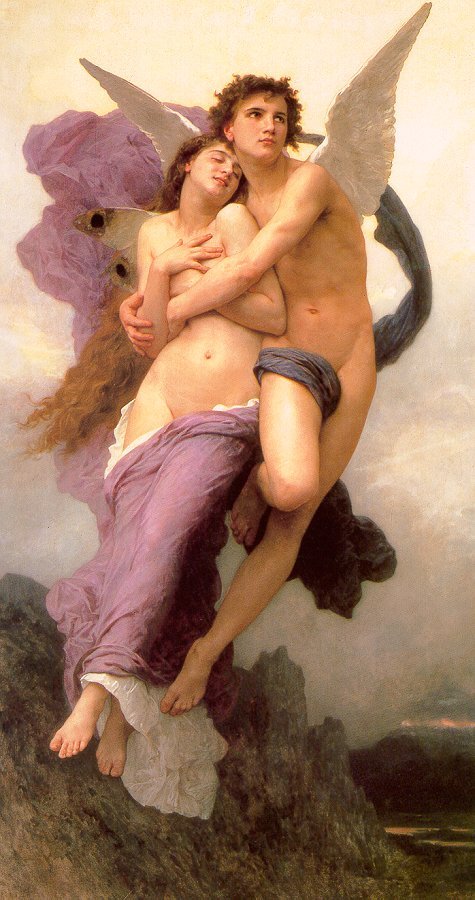
If I'm going to have a bowl of china with fruit in it, I want to see that bowl being thrown across the room by an angry housewife, shards flying, fruit bouncing, husband ducking, and dog hiding under the table. Or if it's a nude, I want to see his arms flailing against the angry Furies or him leaping skyward with his arms wrapped around his lover and his eyes aimed at the heavens. A lot of nudes stampeding would be fine, too, as long as I can determine what spooked them.

At the very least, make the nude tell me something meaningful, say for example, by means of a well-planted foot, a plaintive reach, or a furrowed brow. That way I don't have to spend all of my time focusing on his or her pleasant but otherwise standard parts, and instead I can ponder something more important — and more rare.

That is art; everything else is just a painting.

[Edit: I learned that still lifes are even more boring than I imagined. I'm told that the spectacles aren't symbolic of anything. They just provide a reflective surface, which is difficult to paint. (I also fixed the links to Orestes and Psyche).]

Labels: ,

Saturday, September 02, 2006

The Republican Prince

Alas! If only I lived in the UK, I could have attended the Edinburgh Fringe Festival in order to watch this interesting-sounding play: The Republican Prince by a young playwright named Henry Afton.

On second thought, maybe I don't want to live in the U.K. There's that messy business with Britain's Racial and Religious Hatred Act, not to mention the notorious NHS. Never mind, then. I'll take our version of a mixed economy over theirs. Even so, had I known about this play earlier in the year, I might have used it as an excuse to visit London.

I have no idea whether the play is worth seeing. But the premise! The premise!! (Did I mention the premise?!) How often do we get to see a modern play that even attempts to tackle such a theme? Rostand has been dead for 88 years now, Hugo for 121 years, and Shakespeare for 390. It's been a very long time. (I mean no offense to the delightful and talented Richard Rodgers, Oscar Hammerstein II, W. S. Gilbert, and Arthur Sullivan; it's just that I never quite understood the early and mid 1900s, especially the technicolor frivolity of its musicals.)

As for me, I'd love to see more challenging and Romantic plays make it to the stage, even if it means listening to a bit of hackneyed dialog or stilted acting coming from early efforts. I am personally mindful of the fact that a writer has to begin somewhere. After all, I'm still in the middle of that period of writing myself.

Naturally — or unnaturally, as it were — the critics found nothing good to say about the play. Here's what (new) critic Anna Kay wrote about it in the Edinburgh Guide:

"The supposed heroic climax of the piece is ridiculous and idealistic, rather than in any way feasible."

Sounds good to me! Mr. Afton, ignore those tripe-chomping, mud-wallowing, belly-slithering cynics. Give it your best shot and keep writing!

(—hat tip to Medworth)


Labels: , ,

Thursday, April 27, 2006

Why I Didn't Get an MFA in Literature

Camille Paglia, in an interview on Bookslut (a blog), nails the reason I became a technical writer and refused to pursue an MFA in Literature:
I feel that post-structuralism has deadened not only the students, but the professors themselves, to literature. There’s been over 30 years of it now. Over 30 years. Where is the great work of criticism by any of these people? Where is the great critic? What have they produced? Nothing.

It’s just a bunch of gobbledygook, all reflecting each other. There’s no single great work that’s come out of criticism in the last 30 years, in the way Cleanth Brooks’ Well Wrought Urn has that kind of relationship, a book you could recommend to let someone know what’s happening in literary criticism. It is such a dead end, a terrible dead end, and what has happened is that talented people have fled the graduate schools. People have to wake up to this. The people at the top now, people from my generation, who are in the Ivy League, from coast to coast, to Berkeley, their work is mediocre. They have not done what they claim to do, and what they’ve done is driven out talented people.

I meet them everywhere, people who started graduate school and left it, OK? They’re in publishing, they’re in media, they’re in all kinds of jobs, because they couldn’t stand it. They wanted to study literature and art, but had every obstruction put in their paths. They not only had to read Lacan, Derrida and Foucault, who had nothing to do with literature, but they had to read critics talking about Lacan, Derrida and Foucault, none of whom are philosophically trained, okay?

I had professors telling me that I should pursue a degree in Lit. They would often select my essays and recommend them for scholarships, awards, readings. Even my fellow students enjoyed my work. There was great promise. But I wouldn't be a part of the nightmare that was Lit studies at the time. I'd seen enough of that as an undergrad. Following that path would have been suicide for me. (And anyone who knows my intense personality would understand that comment.)

If I ever become a successful fiction writer — and I fully intend to — it will be due to my own self-study and hard work. Sure, I could wish that I had been born during some other time, but unfortunately that's not reality. Instead, I just put my head down and drive on, and I know that I'm much happier for it.

I do hope, though, that I will live long enough to see some kind of rebirth in Literature, a vibrant new class of scholars, writers, and students flooding our universities with new blood. As my partner likes to tell me, "You just might be a part of that rebirth." That's a nice thought.

Labels: , ,

Saturday, February 04, 2006

"A Farewell to Arms" (Part II)

In terms of volition, there are at least three kinds of heroes in literature: Accidental, Bumbling, and Goal-directed. Lieutenant Henry is an example of an Accidental Hero. He pulls off feats only in the face of grave or sudden adversity. He rises to meet life’s challenges and so deserves credit for pulling off a difficult stunt now and then.

Consider two men flying a Cessna aircraft, a pilot and his non-pilot friend. When the pilot suddenly dies of a heart attack, what will the non-pilot do? If he goes berserk or makes bad decisions, he will likely crash the plane and die. If he shows ingenuity, he may extend his life or even survive against all odds; this is the Accidental Hero, and I suspect that many people, to the extent of their physical and mental capabilities, would rise up and become such a hero if their highest values were threatened. Henry is such a hero; he deals with adversity only when it comes his way, though not always successfully.

The Bumbling Hero, on the other hand, isn’t a hero at all. If he lands the plane, it’s because he mystically manages to push all the right buttons and pulls all the right knobs while singing “Tweetle-dee” and ejaculating about his “awfully bad luck,” and while not displaying a scintilla of good sense. How many billions of times can writers churn out these obnoxious rubber ducks? Ask Hollywood.

There's a third and better kind: The Goal-directed Hero. He is the one who bends circumstances to his will. In literature, he is the originator both of conflict with his enemies and of resolution by his own action. By “conflict with his enemies” I don’t mean that he initiates force against others. I mean that in the pursuit of his goals, he will necessarily encounter resistance (in the context of literature) and will overcome them (in the context of my literature), this in contrast to the Accidental Hero whose antagonists, by their primary actions, cause him to rise up and act in self defense. My protagonist—the Goal-directed Hero—will always take (positive) action first.

Labels: , ,